

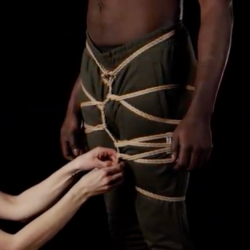

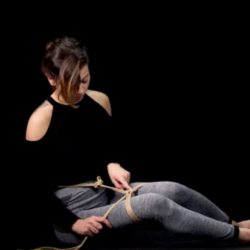


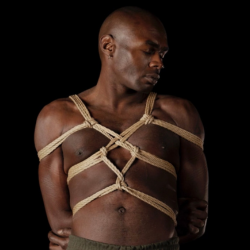

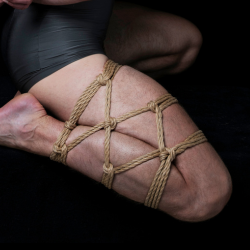
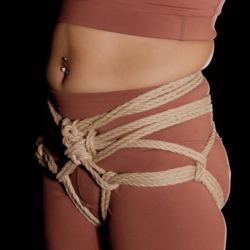
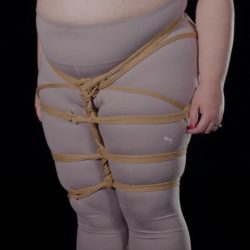


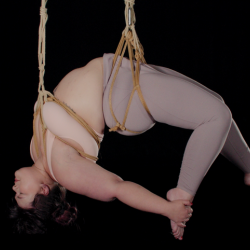


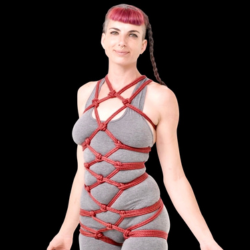
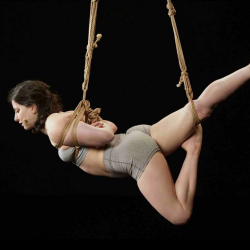



Musing Thanks for asking! Fuoco here, and I’m going to reply as myself. The simplest answer to your question is that we always defer to the creator of any harness regarding best practices for use, as they have likely played and experimented with their own harnesses more than we have. What I personally see here as things I would want to adapt about this harness if I were to use it in suspension are: 1) the stem in the back hasn’t been constructed to isolate the tensions in the wraps. This would be a fairly simple modification, but I would suggest a more robust friction at both the top and bottom wrap in the back. 2) because the harness comes together in the middle in the front, there’s a greater likelihood of the bottom wraps slipping up in suspension, especially on someone without a lot of chest tissue as Anna Bones mentions. You could adapt this on a case by case basis, but I would consider adding some sort of downward anchor to the waist using a hishi pattern technique!
Shibari Study Support
Berlin, Germany
Replied on Figure 8 Chest Harness | Tutorial
Replied on Reverse Tension
Replied on Flying The Agura
Replied on Agura Transition Sequence | Class
Replied on Self-Tying Legs | Intro
Replied on Using Carabiners
Replied on Preparing And Adjusting Ankle Ties
Replied on Butterfly TK Suspension
Replied on Kinoko's New Hip Harness | Class
Replied on Bottom Lock-Off
07 Aug 22:55
You can definitely go through the Y-Hanger. You might opt to use the double bight if your hanger is perfectly balanced and you don’t want to change that and/or if you anticipate leaning your bottom back on the upline, which might make it hard to then untie (and in which case a lock off above the double bight would remain accessible)