





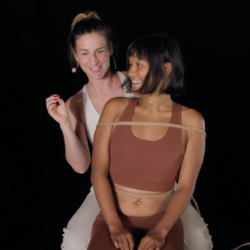


Tantra & Shibari: “In what way is this Tantra?”
“In what way is this Tantra?” is a comment left on social media in response to one of my posts that presents my upcoming workshop entitled “Shibari and Tantra”.
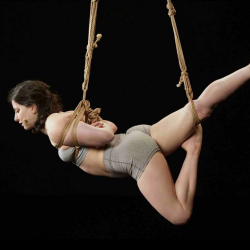
A small introductory clarification but not a minor one, I titled this workshop “Tantra & Shibari”. The conjunction “&/and” does not express that Shibari is Tantra. This conjunction expresses a combination of practices not a fusion of the initial meaning of the two terms.
After this brief grammatical introduction I want to specify that my words are not a simple defensive impulsive reaction but a real reflection.
Let us return to the comment/ the reflection.
“In what way is this Tantra?”.
This leads me to ask (again) the question, what is Tantra? I do not like to remain on my certainties. I like to revisit my own thinking however uncomfortable that may be at times. I invite you to do the same.
It brings to mind the same questioning in relation to the teaching of yoga that I have shared my vision and my practice for 22 years. Because can I teach outside of my vision? In a way that is not biased? Objective? Universal?
Yoga which I currently practice in a club that has three studios in my city (I received a free unlimited one month subscription so I am experimenting), transmitted completely differently, emptied of its subtle, spiritual substratum, relegated to the rank of bodily or even sporting practice… This does not prevent me from including that aspect. Just as I can experiment with every moment of my daily life on a pragmatic level or on a spiritual level (or other) including/ opening other levels to my experience or not. I could also slam the door and say “In what way is this yoga?” This would comfort me in the idea that I am right or that I know better? That I am an expert! Hoouuuu then Uma’s ego happy!!!
Like the anecdote of the 6 blind men who can only speak of the part of the elephant with which they are in contact. Can I really say the whole of the elephant when I only perceive one of its ears? By telling the one who touches its tail: “In what way is this an elephant? The elephant is wide, flat and soft and not long and thin…”.
We could also take the comment in the opposite direction: “In what way is it not Tantra?”. Is it not the nature of the “divine” or the mystical to be unnameable, non prehensile, undefinable…
And if practicing Shibari allows me to discover parts of myself that have been repressed, unconscious, unknown until then; is that not Tantra?
And if thanks to Shibari I could recognize how I use my power or let myself go into my vulnerability in connection with the other? If I discovered a new ability to get out of the mind and live the experience totally present, is that not Tantra?
Is tantra not a path of (re)knowledge of oneself?
From what I have understood of Tantrism, it is a non dualistic approach that infuses all moments of our lives and not only the moments of practice during workshops or massages or formal moments.
A path of self recognition defined mainly as a style of spiritual practice rich in techniques, embracing the world rather than denying it, embracing all that composes us rather than repressing, attempting to suppress some of our parts, our impulses, our desires, our likings or dislikings. Using each of our intentions / desires, actions, emotions, sensations, experimentations… as a vehicle to explore consciousness.
One of the original apothegms of this path in its historical context, was it not to show that even when one steps outside the traditional, it remains divine like the Hindu or yogic precepts that say and define what is good or better and what is bad or lesser?
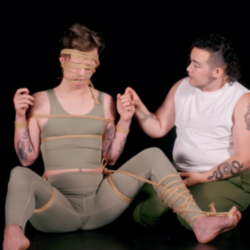
And if practicing Shibari allowed one to be in direct and immediate experience of what is without passing through the mind? And if the restriction of the ropes invited a total presence and therefore non duality which also allows one to transcend the illusion of separation?
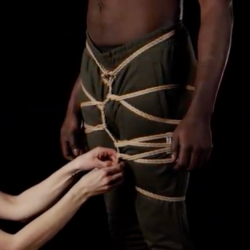
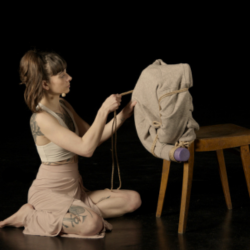
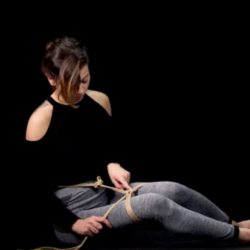
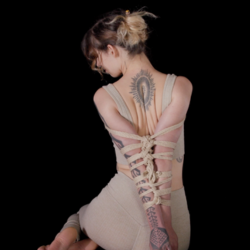
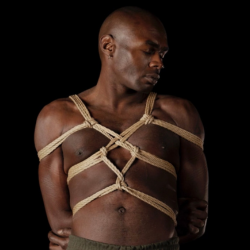
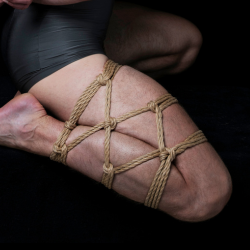
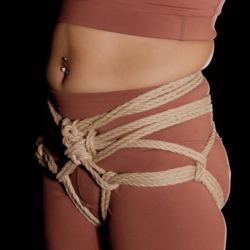
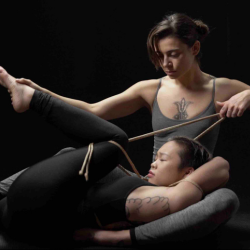
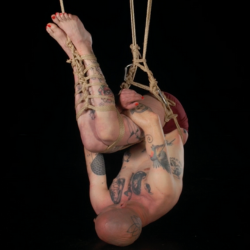
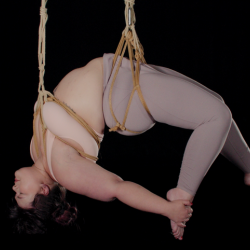
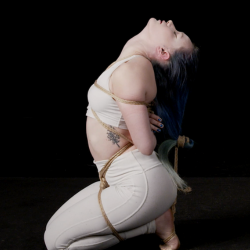
The rope which is and represents the link between the two people intensifies the sensation: for the person tied the more tension there is in the ropes the more they can feel the intention of the movement of the one who ties. When tying someone well I can feel the movements of the breath of the person who is on the other side of the rope. Is this not again being totally there and in connection with the other?
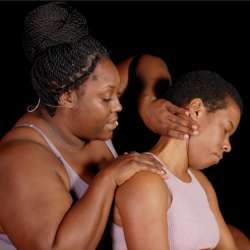
What difference is there between approaching a body with oil during a tantric massage (“That is Tantra”) or with ropes during a Shibari session? (“That is not”?).
I also hear self proclaimed purists jump because “Tantra and shibari” that is not tradition.
Is Tantra not originally in its approach a path of exploration of oneself? Of the union Shiva / Shakti inside rather than during practices where for example women are invited to take a scarf and men a stick…? Or a bowl and a sword… I also observe proposals of tantra workshops where gender parity is asked, is genring Tantra, is that always Tantra? Does that belong to the essence of the path? As a woman am I not obviously free to take the sword and the man the bowl?
What have I not understood of tantra to ask myself the question?
If during practices mainly centered on sensuality or even sexuality and the encounter with someone with sexual orientation polarized with mine I do better Tantra? Or again during “Rosetta” proposed by Margot Anand it seems to me, where one performs a massage of the anus in duo there I am in the right? And not by doing Shibari?
“It is a transposition of metaphysics, which must be of absolute rigor in essence but of absolute freedom in form, this is the deep meaning of tradition, like an immutable truth that can, that must even adopt very different forms according to time, places, people taught, otherwise it stagnates and degrades in weighing ‘traditionally’. The decoding of all perceptions into vibrations, this de objectification of the world, is the heart of Kashmiri Tantra and distinguishes it radically from the Vedantic approach. Transposing itself according to our abilities through the 5 senses this energy will find its place of revelation in the space of the sixth sense, the felt experience.” 1 2
In my eyes this non dualistic approach also fully applies to that of a somatic approach as Shibari can allow. All roads lead to Rome but it is so much more convenient for the ego to reassure itself by thinking it knows, is right and believes that its path is the path.
If yogic techniques, asanas, pranayamas… are part of tantric techniques, in what way is the new rhythm of breath that I must find when I am restricted by ropes not a means to consciously experiment through my breath? In what way would that not be pranayama which invites in certain advanced techniques to perform retentions lungs full or empty, at a faster or slower rhythm?
Exploring polarities other than the classic “Shadow/Light”, “Masculine/feminine”, would that be more tantric than exploring themes such as: “Power and Vulnerability” or terms unfortunately very worn out such as “Domination/Submission” with the medium of ropes?
Are we not already exploring the body and its sensuality in plenty of tantric practices, is that not also the case?
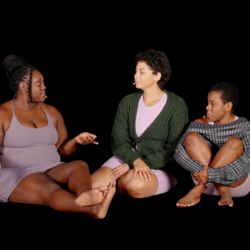
Being able to express to the other one’s intention in the session, being aware of one’s limits, one’s fears is that not Tantra also?
As soon as a word steps outside the referential of these so called experts/purists/representatives of a path/tradition, it is no longer in the tradition…
Author: Umâ
1 & 2: Eric Baret, Corps de silence, Editions Almora*