Microbondage: A Little Idea For More Creative Shibari
Looking for ways to expand your rope practice? Your instinct might tell you to “think bigger”, but what about zooming in? Microbondage may be just the little big idea you’re after…
One of my ambitions as a rope top is to take myself less seriously. I take the craft, risk, and history of shibari seriously, of course, but I’ve been working on separating my ego from my practice. This has been manifesting in a lot of different ways, but one that has enabled me to embrace silliness as an antidote to seriousness is microbondage. I have found it to be an effective way to break me out of my regular patterns, get a little goofy, challenge my assumptions, and explore my creativity as a top and self-tyer. Hear me out...
What is microbondage?
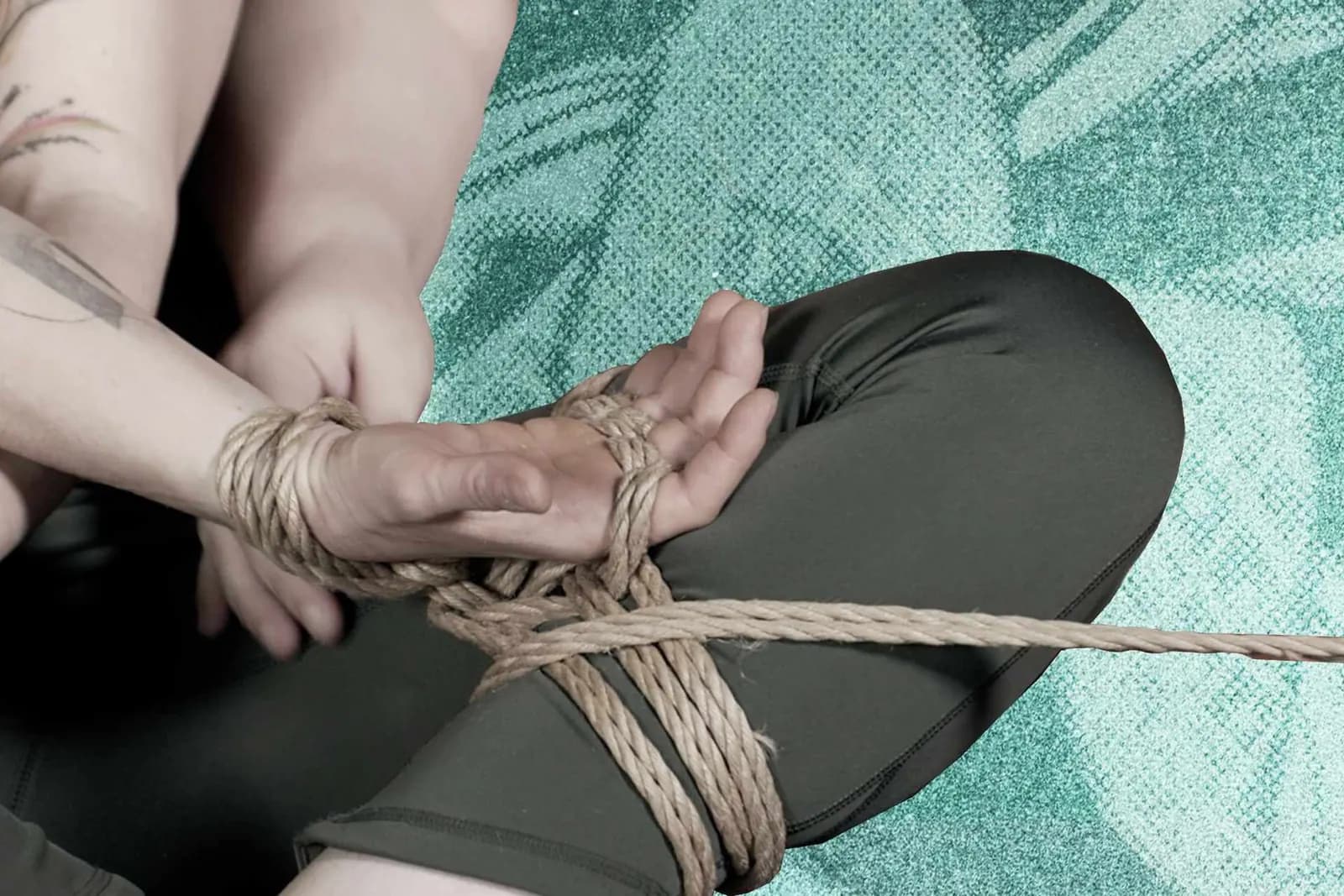
Microbondage usually refers to tying of the smaller, more delicate parts of the body – think fingers, toes, tongues, nipples, breasts, and genitals (you can dive deep into this style of bondage in Anoxia’s Microbondage course on Shibari Study). The term ‘microbondage’ is also widely used to mean the use of thin ropes (4mm jute, for example), strings, ribbons, or even dental floss to tie the body. Often the smaller parts of the body are the willing victims of a top with super thin ropes (micro-microbondage?), but these materials can be used on larger parts of the body too.
Whether you're looking to inject some absurdity into an overly serious session, unleash something genuinely mean onto a willing body, or explore the stranger, squishier, stretched out edges of humiliation and predicament play, microbondage can do that, and more.
For the purposes of detailing my own journey, what follows is largely my experience tying with thinner ropes – sometimes using them on smaller body parts, and sometimes exploring how they can be employed on larger surface areas. However, I invite you to find the approach to microbondage, and indeed the definition, that best suits your practice and desires – either way, I hope you can find some inspiration here.
Beyond my personal enjoyment, I am an advocate for exploring microbondage for a couple of reasons I have classified as “the cute, the mean, and the ugly”. Whether you're looking to inject some absurdity into an overly serious session, unleash something genuinely mean onto a willing body, or explore the stranger, squishier, stretched out edges of humiliation and predicament play, microbondage can do that, and more.
Microbondage: the cute
Everything is cuter when made into a miniature version, including shibari. It’s undeniable that a tiny double column tie around two thumbs is the cutest thing imaginable. It screams silliness, especially if that’s all your top puts you in after you’ve been begging to be tied all week. The absurdity of it can create joy, laughter, and playfulness in a tying session. These are themes I think we all need more of when it comes to rope, which can tend towards overly serious (a side effect of the fact that it is a super technical, high-risk practice, and also due to the popularisation of more ‘torment’-focused rope styles like semenawa).
A little bit of microbondage can also be a great scene starter: I really enjoy rope sessions that start off light and even frivolous, lulling the bottom into a false sense of security, and then take them deeper into more intense sensations and emotions.

A little bit of microbondage can also be a great scene starter: I really enjoy rope sessions that start off light and even frivolous, lulling the bottom into a false sense of security, and then take them deeper into more intense sensations and emotions. Alternatively, as Anoxia explains in their course, it can be a powerful scene finisher, creating a sense of completion and total immobilization in a tie as even the smallest structures like fingers and toes are roped in. Whether you start or end small, this is one way we can create emotional variation within our sessions in a creative and fun way.
Microbondage: the mean
Thinner ropes have a more ‘slicey’ and wire-like effect compared to thicker ones, especially if applied with high tension. However, the impact of this will be concentrated on the area of application, meaning that if you want to simulate the feeling of truly being immobilized in a tie, as well as enjoy the benefits of the pressure, you’ll need a lot of rope. The implication here is that often tying with many thin ropes takes a really long time – this could be a bug or a feature, though!

One of my favourite ways to get mean on a smaller scale is with a microbondage predicament particularly well suited to bottoms with breasts. I like to create a lark’s head and lasso the nipple, allowing it to tighten down before wrapping it around the entire breast, or creating a predicament by tying it off to another body part. If they move the other body part, the nipple suffers. Sometimes, because it’s a simple lark’s head, movement of the other body part could cause the nipple tie to detach (oh no!). Of course, this is an excellent opportunity to “blame” the bottom and “punish” them for what was obviously their fault. Silly little ties like this can be an excellent way to play with concepts of predicament and “funishment” (when the punishment for losing the rope is actually something fun that the bottom wants, like getting spanked).
Microbondage: the ugly
If you’re into themes of consensual humiliation and degradation, microbondage might be for you too. Taking a beautiful face and messing it up with a length of rope or fine twine is really fun. I like to have the bottom stick their tongue out (for which I chastise them, of course, because how rude). Once they have giggled and become embarrassed, I ask for it again. This time, I grab the tongue in a lark’s head and tighten it down. Having someone by the tongue is already intense, so I proceed slowly from this point. They might start to salivate and dribble spit all over themselves, or the floor, or you! This is excellent fodder for shame play and embarrassing them with your words, especially if you told them they can’t mess. I like to take this tie, and with the rest of the rope, wrap their face and head a few times to disrupt their beauty.
I find that a different kind of beauty emerges from this so-called ugliness. By really taking myself, or another person, all the way into something “ugly”, there is a transmutation that happens.

I’ve also been really into self-tying with thin ropes in the last while. I find that the thinner the rope, the more pronounced the beautiful squish that emerges from the meeting of rope and flesh. This allows me to experience my body differently and find satisfaction where, in everyday life, internalised fatphobia has me tucking away my rolls, lumps, and bumps. Rope, and especially microbondage, brings sensation rather than appearance to the fore, and allows me to enjoy, through touch and pressure, that which Western society deems unsightly – my fat and flesh.
I find that a different kind of beauty emerges from this so-called ugliness. By really taking myself, or another person, all the way into something “ugly”, there is a transmutation that happens.
10 microbondage safety considerations
Before you go to (tiny) town, it’s essential to understand that tying more delicate parts of the body, especially with very thin rope, carries its own specific risks, and the very qualities that make it exciting (concentration of sensation, high tension, small surface area) are the same ones that can cause harm if you're not paying attention. While by no means extensive, the following considerations should always be front of mind when practicing microbondage and, indeed, any type of rope bondage.
- Be mindful not to allow too much freedom of movement in the joints. As Anoxia explains in their Shibari Study course on tying small body parts, if you’re including the fingers in a tie, it’s best to pin the limb to the body to limit the range of motion. If the bottom has too much range of motion available, they can change the tension of the ropes binding their fingers, increasing the risk of overextending the joint (which is a recipe for injuries like tendonitis and dislocation, as well as sensory nerve damage).
- Think about the cumulative risks. When you add flourishes like tied fingers after you have already tied other structures (a box tie, for example), you can run the risk of not being able to use the fingers to gauge for nerve symptoms in other parts of the arm. Hand checks are a part of managing the risks of ties that include the upper arm and forearm. Tied fingers reduce our ability to meaningfully perform these checks.
- Don’t ignore circulation changes. Gentle and mindful rope handling is imperative here. If you notice that an area becomes extremely engorged with blood or, conversely, cold to the touch, untie and check in – you can always take a quick break before continuing. Circulation symptoms can mask other more serious injuries.
- Avoid twisting or deforming body parts under tension. This applies everywhere, and especially to the testicles. Thin rope under high tension concentrates force in ways thicker rope does not.
- Don’t skip the non-verbal signal negotiation. When the mouth is involved in the tie, verbal safewords stop being an option. Agree on a clear, unambiguous signal before you start. Every time. Without exception.
- Don’t assume your materials are body-safe. Not all thin ropes, strings and twines are created equal. Synthetic twines can carry rough fibres or chemical treatments that are harmful on sensitive skin. Stick to softer fibres like cotton for anything going near genitals or faces. And dental floss, despite its appeal as an absurdist prop, cuts into tissue under tension more readily than you'd expect. Proceed with real caution.
- Safety shears are still essential – yes, even for thinner ropes. Untying many thin ropes takes a long time. The ability to get your partner out quickly is not optional.
- Keep the eyes closed when tying the face. I’m talking the bottom’s eyes, just in case that isn’t clear! During any facial tie, the bottom should protect their eyes by keeping them shut to prevent rope fibres causing irritation or injury. While tying, avoid the eye area altogether: cheeks, upper lip, brow, and forehead offer more than enough surface area with which to play.
- Take your time. As Anoxia mentions in their Shibari Study series on microbondage, when you are tying more delicate joints where the risk of injury is greater or areas where the skin is thinner, taking your time and laying rope in a more considered way reduces risk. If you are using thin ropes on a larger part of the body, you may need to make many more passes over the body for the person to feel like they are truly tied. Either way, enjoy the slow build-up.
- Embrace the tension. If you’re trying out thinner ropes or string for microbondage, especially for the first time, my suggestion is to start your explorations in areas of the body where there is a lot of meat to withstand the more focused pressure of the rope. Upper thighs, wrapped over and over with twine, create beautiful bulging landscapes of sensation. Here, higher tension in thin ropes creates a lovely sensation that can be layered, with significantly less risk of injury than, say, finger joints or thin genital skin.
Microbondage inspiration on Shibari Study
If you’re ready to start exploring microbondage in more detail, the following three Shibari Study courses are filled with essential techniques and inspirational ties that’ll take you from head to toe. While these classes all focus on tying smaller body parts, you're welcome to tie with smaller ropes as well: