
















Rope Care & Conditioning
You’ve invested in your rope kit, now how do you care for it? Here’s how Shibari Study community manager Mo Bights cares for and conditions natural fibre rope you’ve already bought…
Thank you for purchasing your Shibari Study rope. As a natural fibre, your rope may benefit from a small amount of conditioning before you first use it, and this guide will give you all the steps you need to get the best from your rope and maximise your tying experience. When using your rope, if you feel it is starting to look a little tired and fuzzy, or feels dry in your hands, you can repeat this process. A well conditioned rope will help in your tying experience, both for the person tying and the person being tied, so make sure you check your rope kit regularly and treat it when needed.
Why Treat Your Rope?
Conditioning speeds up the natural relaxing and softening of your rope into its ideal form, a bit like breaking in a new pair of boots or jeans. Treating rope can help maintain its flexibility and hydration, and improve the feel in your hand or on your body.
Jute rope in particular benefits from special care, and the examples that follow are just one way to treat rope. Try these steps out and know you can always adapt and adjust based on your own preferences as you learn them in the course of your practice.
Detailed Steps
There are some considerations to make with each step that might be useful for those who have never conditioned rope before, or for those wanting a little more rationale behind each step.
Step 1 - Break Over a Carabiner
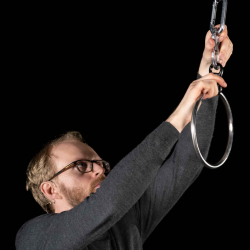
Breaking your rope in over a carabiner softens the fibres and can also loosen and drop some of the shorter fibres from your rope. Start by taking one end of your rope and pass it through a carabiner that has been secured to a fixed point (if you don’t have a hardpoint, you can use a sling or some rope on your carabiner and trap it in a closed door), then take the end of your rope and wrap it around itself 2 or 3 times. Start to pull the short end of your rope back and forth through the twist. Continue to work along the length of your rope until you reach the other end. Try to keep the number of pull-throughs consistent, although around 5 or 6 times should be enough before moving along. You will notice the rope becoming softer and dropping some fibres.
Step 2 - Singe off the “Fuzzies”
After breaking in, your rope will be left with a few “fuzzies”, small fibres that stick out of your rope. These aren’t a problem, but I like to burn them off as it gives a much cleaner appearance to the rope. To do this, I light a gas flame (for which I use a portable camping stove) on high heat and pass the rope through the flame. Keep this moving quickly through the flame and the fuzziness will burn away without affecting the rope. I usually hold about 45cm (1.5ft) between two hands and pass this through the flame back and forth for a second or two, gently twisting to get good coverage. You may find with JBO batched rope this is a little more lively than JBO-free due to the volatility of the batching oil.

Step 3 - Oiling the Rope
Oiling your rope adds additional hydration to the rope. Jute rope can become dry over time and hydration allows rope fibres to move smoothly and reduce friction. I often think of this like skincare: not too much or your rope will become greasy and heavy, not too little otherwise it will be dry and brittle. I apply the oil to a rag, again pulling the rope from end to end and back again. I find applying using a rag gives a more even coverage compared to drawing it through my palm. When selecting an oil, always try to use something that has a long stable shelf life,so this does not go rancid and spoil on your rope.
Step 4 - Waxing the Rope (Optional)
After oiling I also apply a small amount of wax. Wax provides a surface barrier which both helps to keep the oil in your rope and helps to prevent it from wicking up moisture. Wax will also help to smooth the surface of your rope, giving it a cleaner appearance and lustre. Similar to oiling, take a small pea-sized amount of wax and either rub it on the palm of your hand, or onto a small cloth. Run your rope from end to end applying even pressure to distribute the wax across the surface.
Now that you have conditioned your ropes, you should find them to be soft, supple and strong, perfect for tying. Now you are ready to tie, so check out our tutorials catalog for hundreds of tutorials, discussions and inspirational performances to help you along the next steps of your rope journey. If you want to talk to other rope practitioners about their methods for conditioning rope, check out our Shibari Study Community where you can ask questions, get advice and share photos and videos of your rope progress.
Happy Tying,
Shibari Study